
Bohdan Hawrylyshyn. A Ukrainian who influenced the world
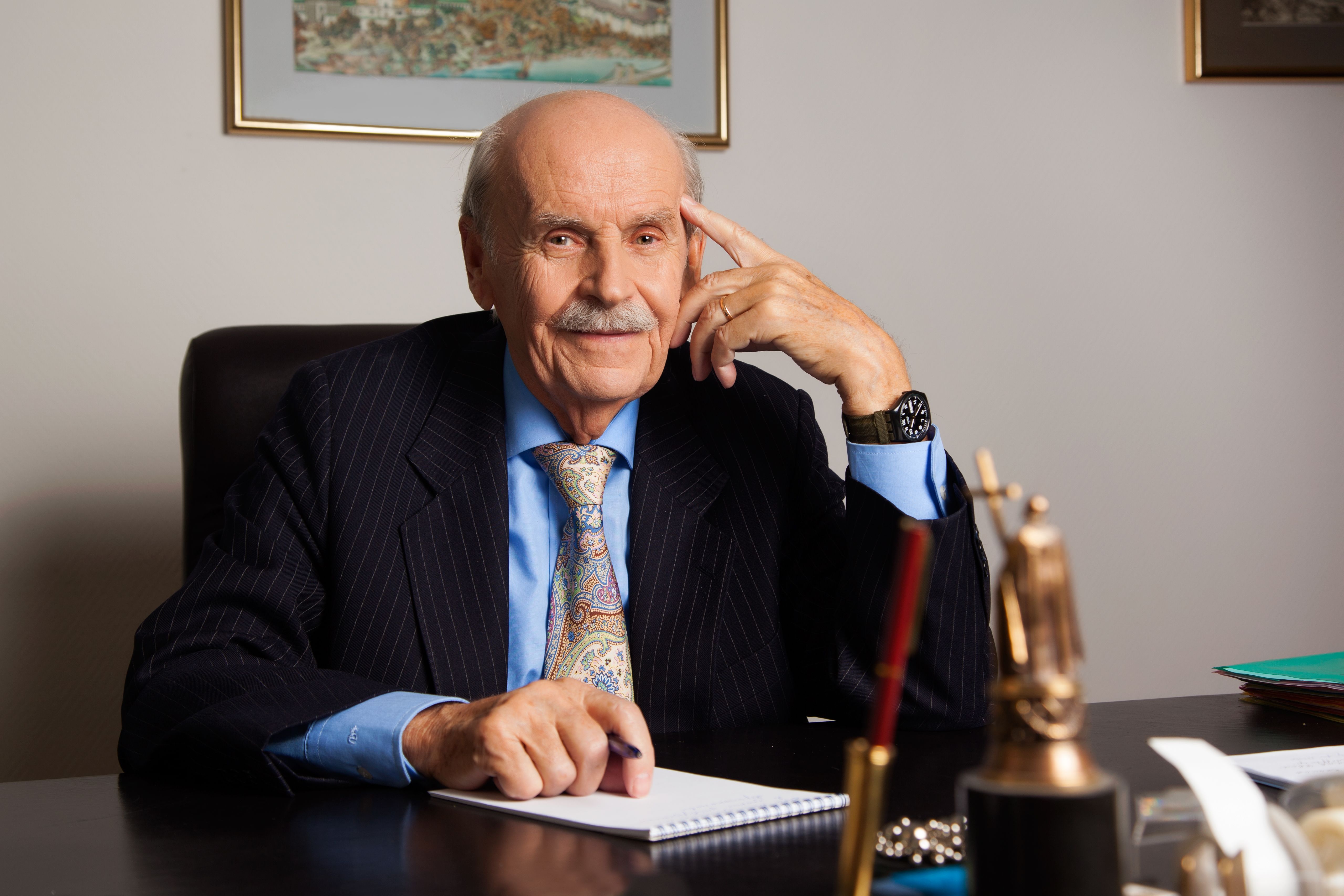
“I have always introduced myself the same way: Bohdan Havrylyshyn, a Ukrainian.” A man who advised presidents and prime ministers of dozens of countries, stood at the origins of the World Economic Forum in Davos, was a member of the Club of Rome community, and, most importantly, demonstrated through his own example how one can carry one’s roots across the entire world.
Bohdan Havrylyshyn was born in the small town of Koropets, Ternopil region, on October 19, 1926, at a time when western Ukraine was under Polish rule. Family traditions and the Plast scouting movement had a significant influence on shaping his young personality.
Sundays in the Havrylyshyn family were a true ritual. His mother prepared delicious dishes, then everyone sang on the veranda while she recited Shevchenko and passages from the Bible. In the evening, his father would tell friends about the countries he had seen during the First World War. Little Bohdan would quietly hide in the kitchen, listening to every word. This was how his vision of the wider world and his dream of traveling freely across it began to take shape.
In 1937, thanks to his older brother Misko, eleven-year-old Bohdan attended his first Plast scouting camp. By the campfire, he listened to stories about the remarkable and tragic chapters of Ukrainian history and the centuries-old dream of independence. Meeting Metropolitan Andrei Sheptytsky had a profound influence on the formation of his personality. Throughout his life, Bohdan Havrylyshyn remained a member of the “Lisovi Chorty” (Forest Devils) Plast unit.
In 1944, during the Second World War, Havrylyshyn ended up in a displaced persons camp in Germany. In 1947, carrying a tiny suitcase and a great dream, he left for Canada to enter university and pursue an education.
Bohdan Havrylyshyn worked as a lumberjack and learned English according to his own formula: forty new words every day, which he would then explain to others, thus teaching them as well. Newspapers would later write: “The first lumberjack to enter university.” By 1960, he had earned bachelor’s and master’s degrees in Toronto, and later a PhD in economics from the University of Geneva.
For 18 years, Havrylyshyn headed the International Institute of Management in Geneva. He was instrumental in establishing the European Management Forum, which evolved into the World Economic Forum in Davos — a platform where world leaders still discuss challenges in the economy and other areas. His books Remaining a Ukrainian and Towards More Effective Societies influenced tens of thousands of people around the world, while governments from Japan to Brazil sought his advice.
In 1988, after decades abroad, Havrylyshyn came to Ukraine. Together with Ivan Dziuba and Dmytro Pavlychko, he approached philanthropist George Soros with the idea of establishing a foundation for Ukraine’s development. Thus, in April 1990, the International Renaissance Foundation was established, with Havrylyshyn becoming Chairman of its Supervisory Board.
That same year, he founded “MIM-Kyiv” in Kyiv — the International Institute of Management — to train a new generation of Ukrainian managers according to international standards. After the restoration of independence, Havrylyshyn repeatedly served as an adviser to presidents and prime ministers. Yet the more he observed Ukraine’s authorities, their lack of openness to learning and their inability to listen, the more firmly he became convinced that Ukraine’s future lay in the hands of its youth.
In 2010, Bohdan Havrylyshyn established a charitable foundation, and in 2012 he launched the “Youth Will Change Ukraine” program. At the time, there were no alternative programs in the country that would provide an opportunity to learn from the experience and successful European practices of other countries and then, after returning to Ukraine, use this knowledge to implement one’s own projects. Among those who completed the program under Bohdan Havrylyshyn’s mentorship were Taras Prokopyshyn, co-founder of The Ukrainians Media; Solomiia Bobrovska, a Member of the Ukrainian Parliament; Vadym Miskyi, Secretary of the Supervisory Board of Suspilne Broadcasting; and others.
In 2011, on the 20th anniversary of the referendum on Ukraine’s independence, the “First of December” Initiative Group was established, with Havrylyshyn among its members, alongside Lubomyr Husar, Ivan Dziuba, Myroslav Marynovych and others. In 2012, they presented the “Ukrainian Charter of a Free Person,” outlining guiding principles for the lives of Ukrainian society.
Shortly before the Revolution of Dignity, Havrylyshyn emphasized that the world was experiencing a crisis of values and that the international relations system was not working for the benefit of humanity. He then initiated the creation of the Declaration of Human Responsibility — a document intended to revitalize the values of freedom, dignity, the rule of law and social justice.
The events on the Maidan confirmed his concerns: by uniting around a sense of responsibility for one another, Ukrainians demonstrated to the world the power of solidarity. Published in October 2014, the Declaration of Human Responsibility was an attempt to propose universal principles for building a more democratic society.
On October 24, 2016, Bohdan Havrylyshyn died surrounded by his family in his apartment in Kyiv. His ashes were buried in a cemetery in his native Koropets.
Today, his family continues the work of this outstanding Ukrainian — his wife Leonida, daughters Khrystyna and Patricia, and son Leslie. In 2017, they established the Bohdan Havrylyshyn Family Foundation, which creates programs for active Ukrainians.
In 2021, the Verkhovna Rada of Ukraine supported the establishment of Human Responsibility Day at the national level. It is commemorated annually on October 19, Bohdan Havrylyshyn’s birthday, to honor his memory and promote his legacy.
Finally…
So, what shall we call this country?
On August 24, 1991, Bohdan Havrylyshyn arrived in Kyiv and went straight from the plane to the Verkhovna Rada. There, he joined a group of seven people who, during a break, were discussing the name of the new independent state. Various options were proposed, such as “Democratic Republic of Ukraine.” Then a simple suggestion was made — reportedly either by Havrylyshyn or Pavlychko — to simply call it “Ukraine.” Although the discussion lasted only a few minutes, the decision proved historic.
The First Fax at the President’s Protocol Service
During the first years of Ukraine’s independence, Bohdan Havrylyshyn donated the first fax machine to the President’s Protocol Service. This large fax machine was an important step toward establishing the country’s international communications. However, due to technical limitations, the machine often jammed and operated unpredictably. In one well-known incident, the text of the national anthem was sent by fax to Azerbaijan, and the machine printed dozens of pages containing only the line “Ukraine has not yet died…” Although the machine had a tendency to “play jokes” on its users, it nevertheless went down in history as the first presidential fax.
Davos: How Was Global Dialogue Born?
In 1968, Bohdan Havrylyshyn became head of the Management Training Center in Geneva, later renamed the International Institute of Management. As the institute was preparing for its 25th anniversary, one of its lecturers — Klaus Schwab — proposed holding a management symposium for European business leaders not in Geneva, but in Davos. Bohdan Havrylyshyn supported the idea and contributed to its implementation as a mentor and organizer. The event took place in 1971 and brought together around 500 participants. Bohdan Havrylyshyn officially opened the conference and moderated the training sessions. The event proved so successful that it later evolved into the European Management Forum and eventually into the World Economic Forum in Davos.
Authors: The Bohdan Havrylyshyn Family Foundation team